By Buddy Jericho
There are things I witnessed during my years working in intelligence operations across North Africa, the Middle East, and Southeast Asia that I will carry with me for the rest of my life.
Among them was Al-Qaeda's use of children as suicide bombers to kill other Muslims.
Children.
Used as weapons against people who refused to accept Al-Qaeda's extremist interpretation of Islam, or who had chosen to cooperate with Americans.
Some of the people killed were individuals I knew personally. Some were informants who worked directly with me. Others were members of their families.
These weren't simply stories I read in intelligence reports. I was directly involved in incidents like these. I witnessed the aftermath and the devastating consequences for families and communities.
I spent years sitting across from men who embraced the ideology behind this violence.
So when friends ask whether I'm concerned about the growing influence of Islam in America, I don't dismiss their concerns.
I've seen what Islamic extremism is capable of.
But my answer is probably not what they expect.
Years ago, an imam I had come to know told me something I've never forgotten.
He explained that many academics and analysts possessed what he called thin data. They had studied Islam, examined statistics, read books, and perhaps spent a few months overseas.
But he believed that I, and very few others, had something different.
Thick data.
Thousands of hours spent listening, questioning, observing, and developing relationships with people inside the cultures and environments that shaped them.
Over the course of my career, I conducted roughly 3,000 interrogations, participated in hundreds of operations, and developed relationships with informants, tribal leaders, religious figures, and ordinary families across several regions of the world.
I don't share that because I believe it makes me an expert on Islam. It doesn't.
I share it because those experiences changed how I understood faith, family, culture, and the power of belief.
And eventually, they changed how I looked at America.
The Islam I Encountered
One of the things that surprised me most was the extraordinary hospitality of ordinary Muslims.
I spent time with families who had very little by American standards, yet they would offer whatever they had to a guest.
I watched extended families care for one another through war, poverty, and tremendous uncertainty.
Grandparents, parents, children, cousins, and uncles remained deeply connected. When someone faced hardship, the family often became the first line of support.
Religion was woven into daily life.
For many of the people I encountered, Islam wasn't simply something they practiced once a week.
It influenced how they raised their children, conducted business, resolved disputes, and understood their responsibilities to one another.
In many areas where I operated, tribal leaders and religious authorities carried enormous influence. Sometimes more influence than the government itself.
I encountered families with sons serving in different organizations. One might work with the police, another with the government, and another might have connections to an insurgent organization.
To an American, those loyalties might seem contradictory.
But when governments were unstable and the future uncertain, the family's survival often came first.
Relationships, tribal affiliations, and religious authority became forms of protection.
These communities were far from perfect. Some of the same structures that provided security also restricted individual freedom and reinforced inequalities.
But there were things I admired.
A sense of obligation to family.
A willingness to sacrifice for one another.
And a conviction that faith should influence how a person lives, not simply what they profess to believe.
Those lessons stayed with me.
The Reality of Islamic Extremism
I also witnessed the other side of that conviction.
And I want to be very clear about it.
Islamic extremism is not an abstract threat to me.
I have seen its consequences firsthand.
I have seen the aftermath of attacks against innocent civilians, including children. I have known people who were murdered because they rejected extremist ideology or cooperated with Americans.
Some of those people trusted me enough to put their lives at risk.
They were not simply sources of information. They were human beings with families, responsibilities, and hopes for a better future.
Their courage deserves to be remembered.
And their deaths should never be reduced to statistics.
I also spent years interrogating individuals who believed their interpretation of Islam justified violence against those who disagreed with them.
Some were highly knowledgeable about the Quran and Islamic history. They were articulate, disciplined, and deeply committed to their cause.
Their actions were not necessarily the result of ignorance.
Some had developed elaborate religious and moral justifications for brutality.
They believed they were serving God.
And when someone becomes convinced that their interpretation of God's will places them beyond ordinary moral and legal accountability, the consequences can be devastating.
There is another reality Americans should understand.
Some individuals who once sat across from me during my years overseas now occupy positions of considerable leadership and influence in the Middle East.
I'm deliberately not naming them.
But it is remarkable how dramatically circumstances can change.
Individuals once associated with extremist movements can eventually find themselves exercising authority over communities, institutions, and governments.
That doesn't necessarily mean they retain the same beliefs they held years earlier. People can change. Political movements evolve.
But it raises a question worth considering.
When someone moves from an extremist movement into a position of political authority, how do we determine whether their underlying convictions have changed, or whether only their circumstances have?
That question matters because religious ideology and political power can become deeply intertwined.
Religious Authority and Constitutional Freedom
I believe Americans should understand the difference between religious practice and religious governance.
Islamic law, commonly referred to as Sharia, is not a single uniform legal code. For many Muslims, it concerns personal religious obligations, moral conduct, and daily life.
But some political movements advocate imposing particular interpretations of Islamic law through government authority.
When those interpretations conflict with freedom of conscience, equality before the law, or individual liberty, they present genuine challenges to constitutional democracy.
I witnessed environments where religious authority, tribal loyalty, and political power were so intertwined that individuals sometimes had little meaningful freedom to disagree.
Leaving a religious movement, challenging a powerful leader, or cooperating with an opposing political organization could carry devastating consequences.
That is not the kind of society I want for America.
And I don't believe we should hesitate to defend the constitutional principles that protect us from coercive religious authority, regardless of which religion seeks to exercise it.
But defending those principles also means recognizing that ordinary Muslims have the same constitutional rights as everyone else.
A Muslim family practicing its faith is not a threat to American democracy.
A political movement seeking to deny others equal rights or impose religious law through coercion is a different matter entirely.
We should be capable of recognizing that distinction.
A Lesson From Europe
Europe offers some important lessons.
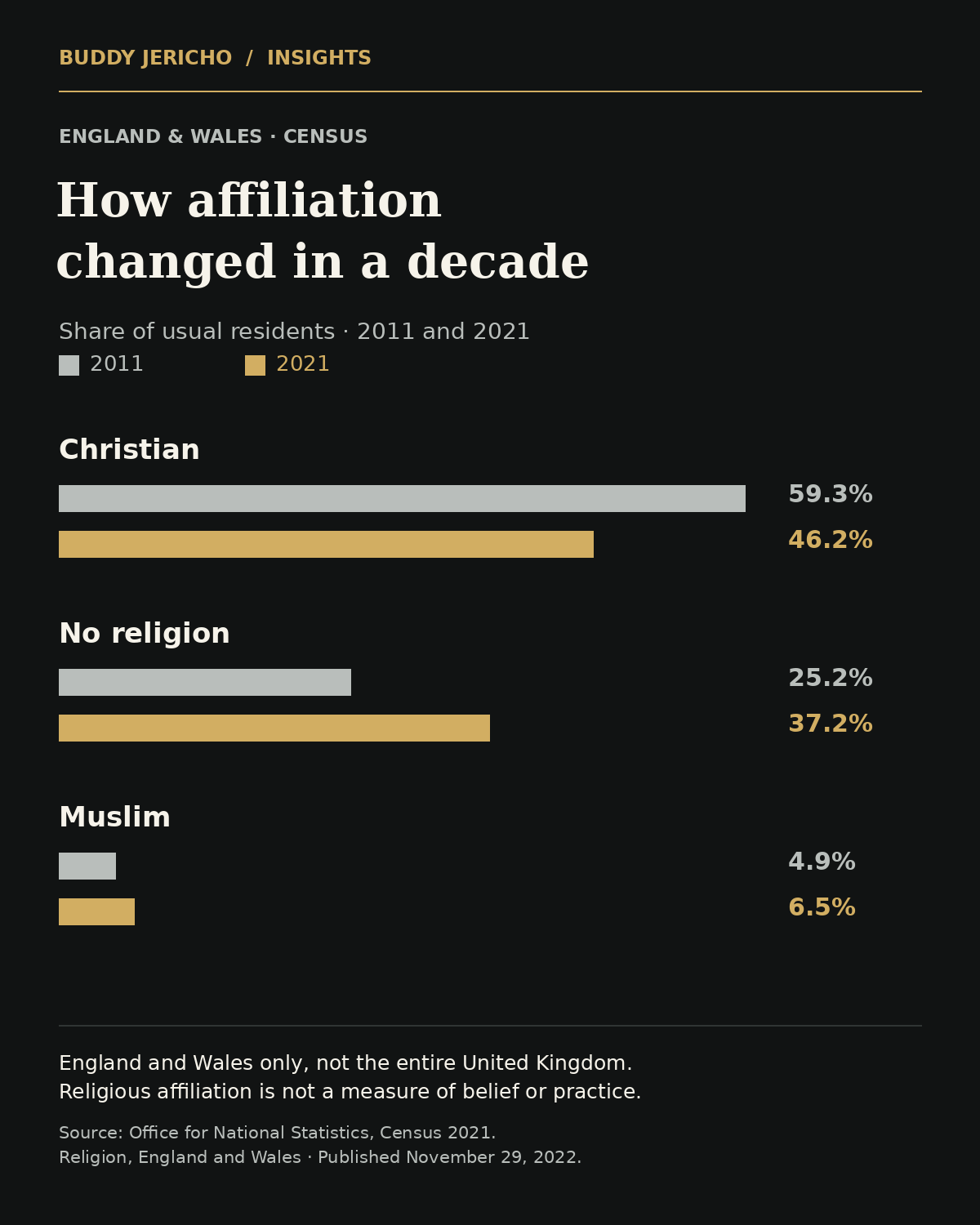
According to government census data, the percentage of people identifying as Christian in England and Wales declined from 59.3% in 2011 to 46.2% in 2021.
During that same period, the share identifying as Muslim increased from 4.9% to 6.5%.
But here's what I find particularly interesting.
The percentage of people identifying with no religion increased from 25.2% to 37.2%.
Christian identification fell by 13.1 percentage points, while Muslim identification rose by 1.6 percentage points.
The United Kingdom has also confronted difficult questions involving Islamic religious practices and civil law.
A 2018 government-commissioned review in England and Wales examined Sharia councils, religious marriage, divorce, and concerns about women's legal protections.
These councils cannot override civil law in England and Wales. But the review highlighted circumstances in which religious expectations and legal rights could become complicated, particularly for women whose marriages were recognized religiously but not legally.
Religious authority does not always require formal political power to influence people's lives.
Sometimes it operates through family expectations, community pressure, or institutions people believe possess moral authority.
I witnessed similar dynamics overseas.
Europe also continues to confront threats from jihadist extremist movements. Europol documented 24 jihadist terrorist attacks, including completed, failed, and foiled plots, in the European Union during 2024.
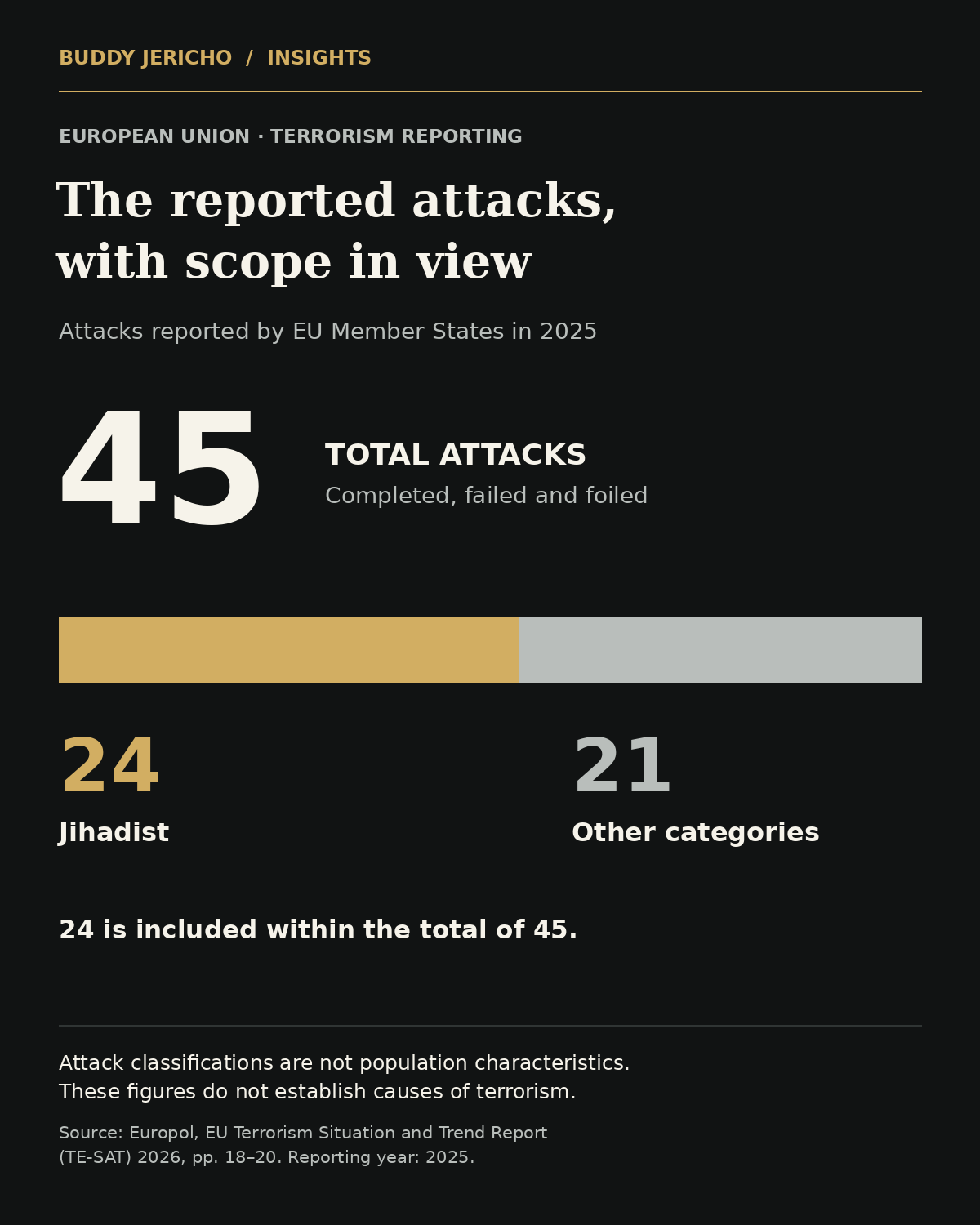
Updated context: The graphic above shows 2025 attack data from Europol’s TE-SAT 2026 report. The preceding paragraph refers to 2024.These are legitimate concerns.
But the growth of a Muslim population does not, by itself, establish growing support for extremism or religious government.
The lesson I draw from Europe is that religious freedom, equal rights, effective integration, and strong constitutional institutions cannot be taken for granted.
And neither can the strength of the communities that sustain them.
What I Noticed When I Came Home
One of the strangest things about coming home from years of intelligence work overseas was realizing that some of the lessons I carried back had very little to do with war.
I had spent years in communities devastated by violence, poverty, and uncertainty.
Yet I had also witnessed families who remained deeply connected, neighbors who looked after one another, and people whose religious convictions influenced almost every aspect of their daily lives.
Then I came home to one of the wealthiest and most technologically advanced societies in human history.
And I began noticing how disconnected we seemed to be.
We had more opportunities, more comforts, and more individual freedom than many of the people I encountered overseas could ever imagine.
But did we have stronger families?
Were we more committed to our neighbors?
Did our religious beliefs influence our daily decisions with the same consistency?
I wasn't so sure.
Over time, I began to wonder whether we had confused material prosperity with the strength of our society.
Because a society can be wealthy and still be weak in the things that hold people together.
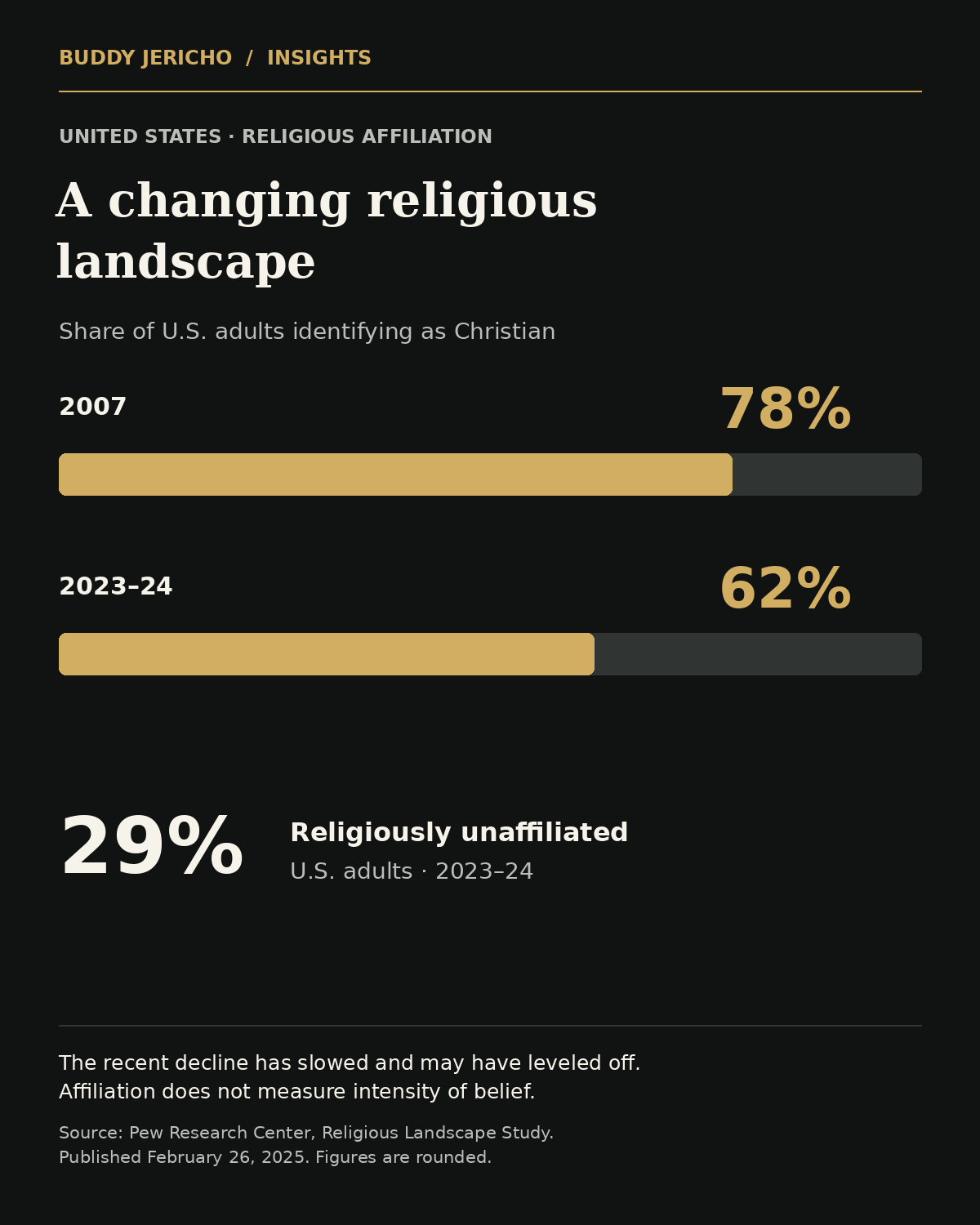
According to Pew Research Center, approximately 78% of American adults identified as Christian in 2007.
By 2023–24, that number had fallen to 62%.
In that 2023–24 study, 29% of U.S. adults were religiously unaffiliated. Pew also found that the decline in Christian identification had slowed and may have leveled off in recent years.
That is a significant cultural shift.
And it raises a question I don't think we're asking often enough.
What happened?
Did Americans gradually reject the teachings of Christianity?
Did churches become less effective at communicating those teachings?
Or did we become so distracted by wealth, individual ambition, entertainment, and politics that we stopped making faith a meaningful part of our daily lives?
I suspect the answer involves all of those things.
I'm not a theologian or a sociologist, and I don't pretend to have all the answers.
But I am a Christian, a father, and someone who has spent much of his life trying to understand what motivates people.
And I can't help wondering whether we've allowed politics to become a substitute for faith.
We increasingly define ourselves by political affiliation.
We divide families and friendships over elections.
We judge people by which side they're on, sometimes before we understand what they believe or why.
And we seem increasingly willing to excuse behavior from our own political side that we would condemn in someone else.
I think about the lessons in Proverbs.
Wisdom. Humility. Honesty. Self-control. Accepting correction.
These are not complicated principles.
But they are difficult to live by.
And perhaps that's part of the problem.
We've become very good at telling other people what they should believe.
I'm not sure we've been nearly as good at living according to what we claim to believe ourselves.
The Question We Should Be Asking
So when friends ask whether I'm concerned about the growing influence of Islam in America, my answer is yes, in certain respects.
I am concerned about extremist movements.
I am concerned about attempts to place coercive religious authority above constitutional law.
And I believe Americans should understand the differences between religious traditions, particularly when those differences involve government, individual liberty, and the rights of others.
I've witnessed what can happen when those freedoms disappear.
But I am also concerned about something much closer to home.
The weakening of our families.
The declining influence of our churches.
The loss of community responsibility.
And the possibility that our political identities have become more important than the values we claim to share.
Christianity's declining influence in America cannot simply be blamed on the growth of another religion.
We have to ask what we've stopped teaching, what we've stopped practicing, and what we've stopped passing on to our children.
Have we allowed politics to become more important than faith?
Have we become so focused on individual success that we've neglected our responsibilities to our families and communities?
And if we claim to follow the teachings of Jesus, would someone recognize those teachings in the way we live?
I ask myself those questions, too.
I spent years studying people whose beliefs shaped nearly every decision they made.
Some of those beliefs inspired extraordinary generosity.
Others were used to justify terrible violence.
What I learned is that beliefs matter. How we interpret those beliefs matters. And what we choose to do because of them matters even more.
I don't believe America's future will be determined simply by which religion grows faster.
It will also be shaped by whether we defend our freedoms, strengthen our institutions, care for our families, and live according to the principles we say are important.
Perhaps the greatest question facing American Christians isn't what another religion believes.
It's whether we still have the conviction to live by what we claim to believe.
About the Author
Buddy Jericho is a former military and intelligence professional whose work spanned North Africa, the Middle East, and Southeast Asia. He is the author of The Man You Become, a book exploring character, responsibility, faith, and the choices that shape who we become.
Sources
Pew Research Center, 2023–24 Religious Landscape Study.
Office for National Statistics, Religion, England and Wales: Census 2021.
UK Home Office, Independent Review into the Application of Sharia Law in England and Wales (2018).Europol, European Union Terrorism Situation and Trend Report 2025.
